Exercises in Frugality, Part 2

Hot Chocolate Mixes

Living here in chilly Wisconsin, we love our hot chocolate. I usually buy big boxes of hot chocolate mix at Sam’s Club, but decided to try to save a few dollars by making my own. Since I have a food processor, this isn’t hard to do.

There are many hot chocolate mix recipes online. Here’s the one I found, with ingredient costs in parentheses (all ingredients purchased at Aldi):

Hot Chocolate Mix

4 cups dry milk ($1.87)

1 1/2 cups sugar ($.26)

1 cup powdered coffee creamer ($.26)

¾ cup cocoa powder ($.50)

½ package instant vanilla pudding ($.25)

Blend ingredients together in a food processor. Use 1/3 cup mix in a mug of hot water.

A mug of this hot chocolate tastes fine. The instant pudding prevents the mix from sinking to the bottom of the mug. So what’s the problem?

The cost! It works out to 14 cents a serving. A box of 60 envelopes of Swiss Miss mix from Sam’s Club is $5.38 for 60 envelopes, or 9 cents a serving. Bummer. I didn’t work out the price ahead of time because I figured homemade would be cheaper.

However, all is not lost. Our son loves a brand of peppermint hot chocolate mix that is a bit expensive. Adding ½ t. of peppermint extract to this mix recipe makes the hot chocolate he loves at far less than its usual cost of 28 cents per serving.

Exercises in Frugality

R2D2, aka DAK

R2D2, aka DAK

Frugality, one of my favorite topics, continues to increase in popularity as the economy negatively affects more and more families.

Some people apparently take frugal tips pretty seriously; note a couple of cranky commenters at this post. Two thought the blogger’s tips were too common, and one misguided soul suggested the blogger stop homeschooling, put her kids in school and start an in-home daycare.

Instead of complaining that someone’s frugal tips are too basic, most commenters helped by sharing their own tips. I think I’ll do the same for the next few posts.

Bread machines

My beloved Oster bread machine died several months ago after about ten years of use. The unit still worked but the pan began leaking oil (or something similar) into the bread because the seal was shot. A perusal of eBay introduced me to a few people* who would love to sell me a replacement pan for $20 plus $10 shipping.

Not interested. Instead, I hit the local Goodwill and bought a replacement, a Regal for $9. It made so-so dough and baked bread that resembled a doorstop in shape and heft.

I waited patiently while watching Goodwill for a new bread machine but kept seeing the same type as the Regal. A blogging friend suggested I buy a Zojirushi BBCCX20 Home Bakery Supreme Bread Machine as she’d had great luck with it. I checked it out on Amazon: $200+, and some (though definitely not most) people had trouble with it.

I know how ticked I’d be if I spent $200 on anything and it didn’t work right. So I decided to keep being patient and checking Goodwill. But then I saw a Sunbeam breadmaker at Walmart for $50. It had pretty decent online reviews, so I decided to use my birthday gift money to buy one, but when I went back, they’d cleared out that model and replaced it with another, whose model number came up empty on a Google search. Not a good sign!

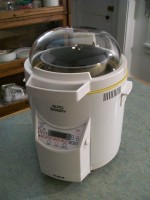
Not long after this, I stopped by Goodwill and found four bread machines. Three were Regals or looked like them. The fourth was so funny looking that I didn’t realize it was a bread machine at first. But it came with recipes, and at $5 it seemed worth the gamble.

Turns out it’s old (1990) and works great! It has quite a fan club, and I can see why. I thought I was being so clever calling it R2D2 until I found out that many people call it that.

Anyway, it makes great bread and dough, it was $50 cheaper than the bread machine I saw at Walmart, and $200 cheaper than the Zojirushi. Definitely worth waiting for!

* Sounds like a profitable racket, so I gave my old Oster and the Regal to my eBay seller daughter, hoping she can make some money off the parts, paddles and manuals 🙂

If Mom Goes Back to Work

Lately I think about whether I should go back into the workforce.

After all, I’ve got only one child (age 16) still at home during the day now, and a husband who’s also at home. If my husband homeschooled our son, I could get a job.

However, according to this article, “Studies have found that for every two years a woman is out of the labor force, her earnings fall by 10 percent, a penalty that lasts throughout her career.”

Hmmm. I’ve been home with my kids for 26 years. 10% X 13 equals 130%. That’s quite a drop! That statistic is not referenced, however, so I can’t check to see if it’s legitimate. Just as well. If it were true, my paycheck amount would be a negative number!

That’s assuming I could even find a job. Somehow I don’t think potential employers would be impressed that I’ve spent the past 25 years raising children and homeschooling them. I doubt that homeschooling is one of the keywords they look for when they scan resumes.  8)

Looks like it may not be worth all the upheaval to be a “relauncher,” as women returning to the workforce are now called. Maybe I’ll stick to being a modestly paid but happy work-from-home writer for as long as I can.

Inspiring Story for Teens

This month’s issue of Money Matters magazine (page eight) has an inspiring story for all teens. If I were still doing Life Prep for Homeschooled Teenagers with my daughter, I’d add it to her assignments for the week.

It’s the true story of a young newlywed couple who has been married for less than two years, has no debt and has $50,000 in savings, all due to their joint effort to manage their money responsibly.

He has a college degree, and she has a one-year technical degree. Both worked their way through college and graduated without debt. Their goals for the future include a large family, a paid-off house and ample donations to missions. What a great example for all young people!

Money Matters is published by Crown Financial Ministries, the organization that Larry Burkett helped start. Listening to Larry Burkett’s Christian financial radio show helped encourage my husband and me as we worked toward becoming completely debt-free, a goal we achieved (not on our own, only with God’s help!) in 2002.  Do check out Crown’s site while you’re there.

Another Dirty Secret about College

There are some facts about colleges that deans of higher education would prefer that you not know.

In addition to the fact that half of all college students drop out before graduation, there’s the reality that most of the high-growth jobs of the future do not require a college degree.

This flies in the face of the common wisdom of the past 50 years that said you must have a college degree in order to get a decent job. That’s true in some career fields (who wants to be the patient of a neurosurgeon who hasn’t gone through college and medical school?) but it’s certainly not true for all fields.

The U.S. government makes projections about the growth (or lack of growth) in different career areas. You can find those numbers at the Bureau of Labor and Statistics (BLS) website. Here’s the latest BLS projection of above average growth and above average wage occupations. It’s an interesting document. Note that the projected increases in job growth are for a ten-year period (2006-2016).

When reading it, keep in mind that a high percentage increase in a given career field doesn’t necessarily translate into a lot of jobs. Check the “Employment” column on the left side of the page for actual numbers (in the thousands).

For example, on the first page you’ll see that the rate of increase for “aircraft cargo handling supervisors” is a healthy 23.3%. But that only equals 1,000 new jobs over the next ten years. Not exactly a booming career field in a country of over 300 million people.

On the other hand, note that while the BLS projects there will only be 10.4% more truck drivers needed over the next ten years, that’s the equivalent of 193,000 new jobs.

Once you become familiar with the chart layout, note the “source of training” column on the right side of the page. Most of the jobs on the first few pages do not require a bachelor’s degree. As you go through the document, you’ll find more jobs that do require at least a four-year degree. There are quite a few.

However, only a few of them show the highest growth potential in both percentages and numbers. They include a variety of tech careers, social workers, jobs in education, and accountants. For those willing to earn more than just a bachelor’s degree, a career as a pharmacist, physician or surgeon would certainly be a growth area to consider.

Still, most of the above average growth jobs that require bachelor’s degrees don’t equal many jobs. For example, only 100 jobs per year nationwide are expected to open up for archivists, anthropologists and archaeologists, marine engineers and naval architects, and atmospheric and space scientists. So unless your child passionately desires to become one of those professionals, you might want to gently point him or her in another direction.

Since many of the degree-required careers have such low projected job numbers, today’s parents have to think seriously about whether a degree is even worth it, particularly if their children’s interests and abilities don’t necessarily fit with the jobs with the most openings and growth in the future.

Again, colleges and universities will not tell you that the degrees they offer do not necessarily translate into good jobs, especially in the working world of the 21st century. This is one area where parents and their teens really have to do the homework for themselves.