How’s it going with your non-homeschooling friends? Do they get what you’re doing? Do they think you’re crazy? Or are they just drifting away……?
A dear friend of mine and I lost our friendship over homeschooling. It wasn’t that she was mad at me for choosing to homeschool, and I doubt that she felt guilty that she wasn’t doing it. Those are the usual reasons that friends split up over homeschooling, at least from what I’ve heard. No, my friend was thrilled to put her kids in school and go back to a job she loved and missed while staying home while the kids were little. I think we just drifted apart because I was so busy having babies and homeschooling them while she was busy working and going back for more education.
Now we just send Christmas cards to each other. As far as I can tell, her kids have grown up fine, and everyone is doing well. I’m happy for her. But do I miss her?
A little. I guess I’m just more comfortable with the homeschooling crowd. They get me. They get what my life is like. And I get them.
To make things even better, being a homeschool mom means finding new friends all over the place. I meet them at conferences, when I speak to support groups, and online. No matter how they homeschool (Charlotte Mason, traditional, unschooling, etc.), we have the joy of homeschooling our kids in common.
So don’t be blue if homeschooling has put some distance between you and the friend(s) you used to hang out with. You’re in a different season of your life, and that may call for new friends. They’re out there waiting to meet you. Why not find a local support group or an online group* and start making new friends?
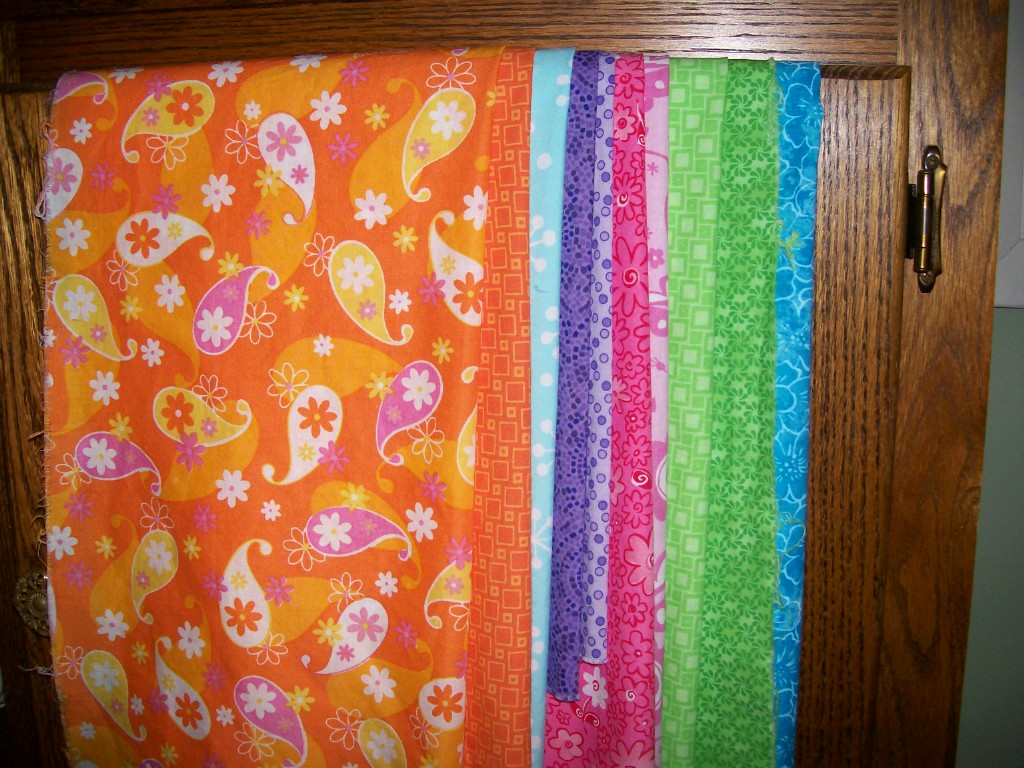
I call this photo “Optimism.” You see, I haven’t made a quilt in a few years, but a friend of mine just became a grandma, and I want to make a baby quilt for her adorable new granddaughter.
So I picked out the fabrics one week, pre-washed and pressed them the next, and was supposed to start sewing this week.
Ahem. Here they are, still awaiting the rotary cutter.
I’m hoping to start sewing very soon. The fact that we’re moving 4-6 weeks from now looms large in my brain. I need to start packing. But I really want to make this quilt! So we’ll see…..
Picking out the fabric was something of an experience, btw. I wanted to buy new fabric because I figured the fabrics from my stash probably look too dated for a modern baby quilt. Most of them are 10-20 years old, and I even have some stuff from the 70s. All of my stash is good fabric, tightly woven with colors that are still beautiful. Most likely, all of my fabric stash was made here in the USA.
Several years ago, I read that most of the fabric sold here in the USA these days is made overseas. Like so many other things, fabric can be produced more cheaply in other countries, so why not? That explains why it took so long for me to find the fabrics I need for this baby quilt. I learned first-hand that cheaply produced fabric is most definitely cheap. I had to reject many fabrics that were not woven tightly, or not printed very well. Even so, a couple of the fabrics I chose because I needed them color-wise are not as high-quality as I would have wished.
Today I learned that there’s a wonderful solution to this problem. One of my favorite quilt supply catalogs, Connecting Threads, has announced that ALL of the fabric they sellnow is woven and printed in the USA from cotton grown in the USA. How cool is that? And the price is still $5.96 a yard….how do they do it? They say they cut out the middleman, and I’m glad they do. Wish I’d known this before I went shopping for baby quilt fabric. I have a feeling that the fabric they’re selling is better quality than the imported stuff.
One of the best things about summer is that it reminds us that educating our children is not just up to us.
You’ll see this when you watch your child at the beach. I get to do this a lot because we’re blessed to have a beach a few blocks from our house. We can spend a lot of time there during the two warm months that comprise summer in northeast Wisconsin.
At the beach, my son takes his shovel and bucket and creates mountains, castles, roads, levees….he just lets his imagination loose and he has a ball. I don’t have to participate at all. In fact, now that he’s older, he prefers that I butt out! He has his own ideas.
When I watch him problem-solve after the tide takes down part of a wall of his castle, or when stray toddlers march through his masterpiece, leaving destruction in their wake, I’m reminded yet again that he’s capable of learning all on his own. He not only fixes the problem, but makes the project even better in the process.
Now, this particular son is 16 and developmentally delayed, but I saw the same thing in my older children when they were young, and I’m sure you see it in yours. God enables everyone to learn. While we homeschooling parents work hard to make a good learning environment for our children, it’s not up to us to make things happen. God has already taken care of that part.
This knowledge can be very freeing, if you’re a conscientious mom who wants to make sure her children learn what they need to know. This summer, give your children a bucket and a magnifying glass and take them to a pond so they can inspect the pond water for living creatures. Hand them a package of colored chalk and let them loose on the driveway or sidewalk. Don’t get involved in what they’re doing. Just watch, and you’ll see what I mean.
What interested me the most is that the rate of truancy increases as children get older, so that by the time they reach 12th grade, well over 40% of them miss at least ten days of school per 176-day school year, and a quarter of them miss 20 days or more per school year.
Some of this can be explained by the fact that 12th graders often have cars and can easily take the day off, drive around town, and no one will notice because they look like the young adults they are, not students. It’s a lot easier for them to play hooky than it is for your average first-grader.
But I wonder if there isn’t another reason so many teens skip school. My memory of the last two years of high school can be mostly summed up by the phrase “relentlessly boring.” Each semester, when I set up my schedule, I squeezed my class requirements into the tightest time period possible, skipping lunch and putting study hall at the end of the day, so I could be out of there as early as possible.
However, I didn’t spend that extra free time loafing. For most of my junior year, I had a job in a hardware store, working from 2:30 to 9 most days. So I needed to get out of school early. But I also had a life, one that extended beyond what was going on in my high school.
Most of my classes were dull, not very useful for the future, or both. There were some useful classes, like typing, home ec and industrial arts, but those of us who were college-bound knew better than to court the possibility of wrecking our GPAs by risking a B or C in those subjects. So I did my best to stay awake through classes that were not very interesting or not very useful: World History via lectures and textbooks, Literature via lectures and textbooks, Sociology via silly games and fake wedding ceremonies. Snore.
However, I took one class during my senior year that was excellent, and I loved it. It was designed and run by one of the school’s social studies teachers, and it was called Public Service Practicum.
The teacher, a highly regarded educator named Richard Chierico, designed the course to help students understand what goes on in local government. He worked out agreements with local government entities, including the village board, the public library board, public works, etc., to allow each of us to work within the system as volunteers, and to shadow various employees so that we would get a firsthand look at how local government operates.
I worked with the public library board, which meant I had the chance to work at all the stations in the library so that I understood just what went on. Then I attended library board meetings after being filled in on the issues by the head librarian. I even attended a gathering of head librarians from all over the region. Having long been a bookworm and regular visitor to the library, I found it all fascinating.
As much as I enjoyed the course, I think what made it extra special is that Mr. Chierico treated us as young adults. He trusted us to go out during the school day to our different posts in local government and to arrange future appointments with our supervisors. He didn’t treat us as other teachers did, as students in need of repetitive instructions and orders. He just expected that we would do what we needed to, and so we did.
I think that’s the problem with high schools, and why there’s such a high truancy rate among older students. What teens do in school is not relevant, it’s not interesting, and it’s too much of what they’ve been doing for all their lives: sit still, raise your hand, you need a pass to go to the bathroom, no you can’t leave campus for lunch. We all know the drill.
Teens are too old for that kind of school. They need to be challenged, trusted and freed. Will some of them bolt if given freedom? Sure, but you can’t imprison everyone because some will run.
Teens are smart enough to know when something’s useful or of value. They’re also smart enough to know when they’re being warehoused. Instead of trying to figure out how to reduce the truancy rate by imprisoning teens further, parents and teachers need to consider other alternatives.
I think this is why so many teens have done well in homeschooling. It gives them the time and the freedom to explore their interests and to consider what they need for their futures. Not to mention, they never need a pass to go to the bathroom.
(For ideas on what useful things teens can do, check out the video below.)
Being a homeschool mom means being on a schedule; there’s just no way around it. The many activities available to each of our children (music, sports, co-op, church, etc.) must be organized somehow, and we’re the ones responsible for that job.
It’s easy to stay in that groove during the summer. There may not be as many activities available as during the school year, but there’s certainly no shortage. Signing the kids up for summer activities can become something we do automatically. But that could be a mistake.
I’m old enough to remember a time when there were very few summer activities available to kids beyond swimming lessons at the community pool. What did kids do back then? We entertained ourselves!
We played games, we had races, we played Barbies, we played baseball.
We ran through the sprinkler, we drew on the sidewalk with chalk, we played hopscotch, we ran lemonade stands.
We rode our bikes, we read library books, we planted and weeded gardens, we played hide-and-seek.
We went to the park, we played on the front porch, we had Kool-Aid and cookies on the patio, and when it got dark, we played Ghost in the Graveyard on the corner under the streetlight.
And all the time we were doing those things, where were our moms? Not entertaining us, that’s where. They were used to having the day to themselves while we were in school, and they weren’t going to give that up. We were expected to be off playing while our moms were busy cooking, cleaning or watching soap operas. We weren’t very concerned about what our moms were doing, because we were having too much fun outside.