Don’t Be Intimidated by Homeschooling for High School (Part 1)

First off, remember that homeschool high school is nothing like public high school, and it doesn’t need to take nearly as long each day. There are no passing periods, no assemblies, no waiting for buses. So there’s no need to stick to the same time schedule that they do. Many people have asked me how long our high school day was. I usually required my teens to work on their studies in the morning, and as far into the afternoon as it took them to finish. I encouraged them to get an early start so that they’d have time to pursue their own interests the rest of the day. (Later on, their various part-time jobs, which we strongly encouraged, also came into play.)

Next, keep in mind that the curriculum you choose will determine how long it takes to study each subject. A very demanding math curriculum will require more time than a basic arithmetic review. Which one you choose will be based on your teen’s future aspirations and goals. If he wants to be a chemistry major in college, you’ll need a solid math curriculum. If he wants to go into the dramatic arts, you’re better off finding a basic math course and spending the time saved on the study of classic plays. And if he wants to be a car mechanic, use that same basic math course so he can spend the time he saves apprenticing with a self-employed car mechanic in your town.

Never forget that the goal of homeschooling a teen is to customize upper level studies to your teen’s needs. Those needs may not be as obvious at age 14 as they will be at 17 or 18; to make matters more complicated, teens change dramatically during those years and so do their needs. But you’ll recognize general areas of interest that really won’t change much. For instance, my son went from wanting to be a computer engineer at 15 to a business major at 18, then felt called into the ministry at 20. As it worked out, he’s now in his late 20s and is a manager for a Christian publishing company with plans to eventually enter seminary as a second career pastor. But during his teen years the common threads we could see were a desire to study beyond the high school level and a love of management and business principles. So we (he and I) designed his high school studies with an eye toward college prep and an emphasis on management.

A friend of mine who homeschooled several teen sons aimed the studies of the first three toward vocational prep because they were clearly “gear heads” who loved doing anything mechanical. But her fourth son was more studious, so she designed his studies to be college preparatory.

Each child is different; one big advantage of homeschooling is that you have the time and opportunity to plan a course of study with your teen (note that I said with) to capitalize on his or her interests and plans. That’s why you need to take all information that you get from books or friends with a grain of salt, tailoring the things you learn to your specific child.

(Excerpted from Stages of Homeschooling: Letting Go (Book 3), now just $2.99. Learn more HERE.)
Help a Fellow Homeschooling Mom Out?

Gina Riley is a homeschooling mom who’s also a doctoral student. As part of her work, she’s looking for young adults ages 18-25, homeschooled or not, to answer a quick survey (about intrinsic motivation and competence, autonomy, and relatedness in education) for her.

Please forward this link to any young adults you know who would like to help Gina out—thanks!

https://www.surveymonkey.com/s/J2LJD95

When Kids Refuse to Learn

(UPDATE 10/16/18 See Below)

We spent an enjoyable Mother’s Day up in Door County (yep, that’s where we used to live, but we still like to go there on vacation.) We had lunch at Al Johnson’s restaurant, where I go to get in touch with my Swedish heritage. We also played mini-golf at Pirates Cove, which my son always enjoys.

While we were there, I couldn’t help but notice a family several holes behind us. What caught my eye was the way the mother was teaching her youngest son, a boy of about five, how to play. She would grab him like a rag doll and jerk him into the proper position at each hole, then reach around him to hold his arms and direct his shots.

He looked really annoyed, and who could blame him? I’m sure his mom meant well, but I don’t think her efforts were having the desired effect. Whenever she took her own turn, however, the boy skipped around with his putter, teased his brother and watched his dad. His face only turned gloomy when he took another turn with his mother glued to him like a backpack.

Seeing her misguided efforts got me thinking about all the ways we try to teach our children. We may instruct verbally, we may demonstrate, or (rarely, I hope) we may grab their little bodies and lead them in doing the activity. While the latter is often resented, sometimes the first two options don’t work very well either. After all, when you have to keep telling kids the same thing over and over, you clearly haven’t taught them by talking to them. And demonstrating doesn’t always work either. I demonstrated how to do dishes so many times to my kids yet often found greasy plates in the dish rack the next day. (I imagine my kids work much harder at getting dishes clean now that it’s their dishes they’re washing!)

The fact is that kids are often not motivated to learn the things we want them to learn. This can result in frustration on their part and ours. Clearly the mother at Pirates Cove cut to the chase by physically manipulating her son into what she considered the proper golfing stance. Perhaps she’d already tried telling him what to do and demonstrating what to do and it didn’t work, so in frustration she turned him into a puppet.

Ultimately we have to ask whether it’s worth humiliating a child to teach him something. Would it have been the end of the world if he hadn’t played properly? Perhaps a few times of losing to the rest of the family because of his lack of skills would eventually motivate him to learn to play better all on his own. Or maybe he doesn’t really care that much about mini-golf; if he’s not a competitive child, he may never care to learn the proper way to play. If that’s the case, I hope his mother comes to accept that this would not be the end of the world. But I doubt it; she looked pretty serious about her mini-golfing to me.

So, how do you react when your child refuses to learn something you’re teaching them? Are some of your children more feisty learners than others? If so, what techniques do you use to teach them?

UPDATE: Since I wrote this post six years ago (can it be that long ago?), I’ve become the grandmother of four children who are now ages newborn, 2, 3, and 6. Watching them grow has reminded me of how eagerly children learn when left to their own devices. You don’t need to coax a child to walk or talk; they’ll do it when they’re ready. When they refuse to learn, we adults need to figure out why. Perhaps they’re being pushed before they’re ready, or maybe they just don’t care about what we’re trying to teach them. One thing I do recall from raising my own four is that when a child’s motivation to learn something comes from within, or once they realize why they need to know something, you can’t stop them from learning. That’s something both parents and teachers need to consider!

It’s a Good Life!

 
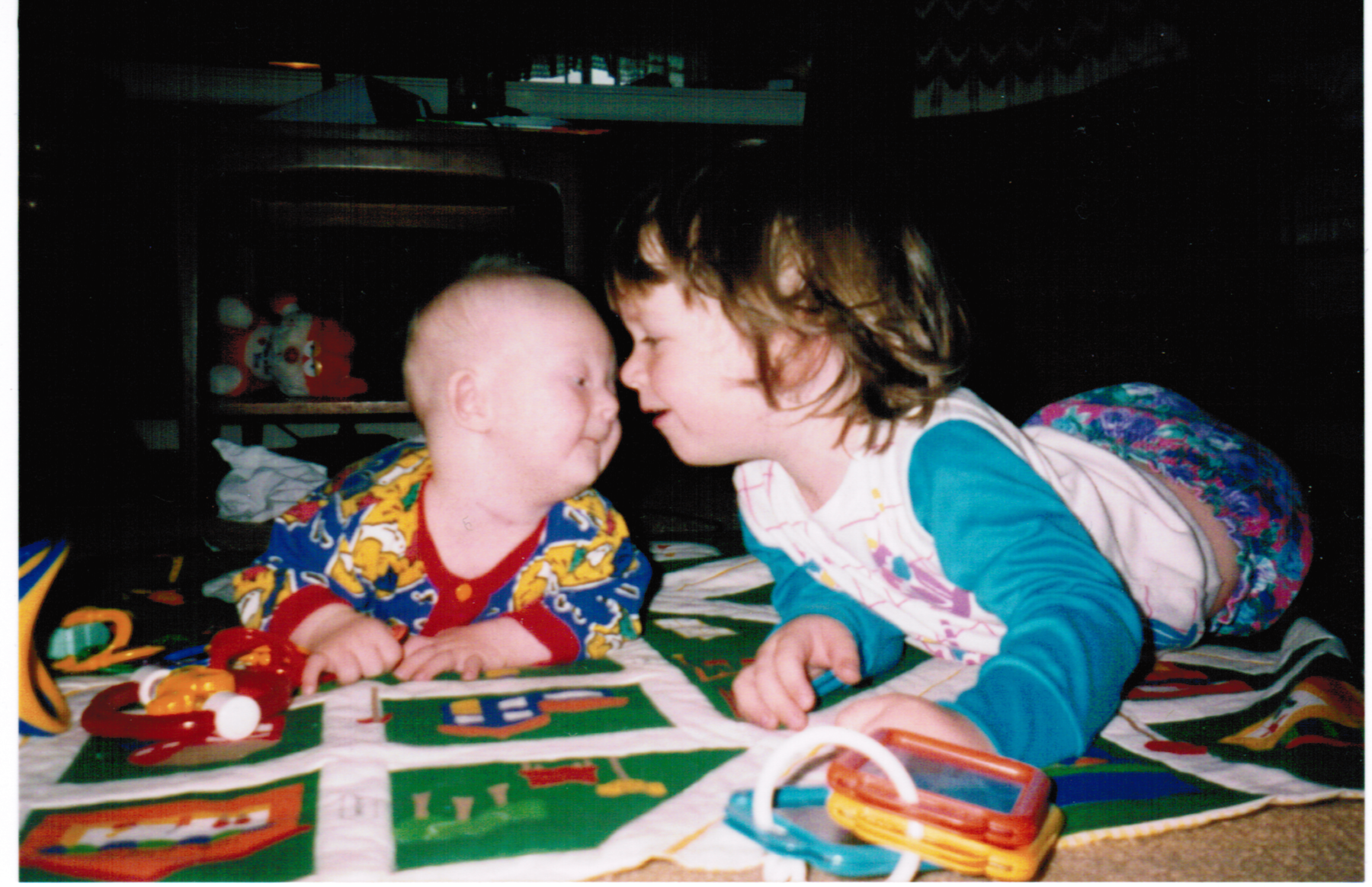
After our son was born with Down syndrome nearly 20 years ago, I researched the heck out of his diagnosis. One of the articles I found that gave me hope was a column by George Will. I knew of him and his reputation as a political columnist, but I didn’t know he had a son with Down syndrome.

The particular column I read was written in honor of his son’s 20th birthday. He described his son Jon as a happy and wonderful human being with personal interests as well as a loving family. It made me feel like having Down syndrome wasn’t the end of the world for our child.

Last week, Will’s son Jon turned 40, and Will wrote another column in celebration of the day. In it he draws a picture of a man who loves nothing better than to take the subway to the baseball game and, after popping in to help out in the locker room, sit and enjoy the game with a cold one.

While many other 40-year-olds spend their afternoons stuck in traffic on their way home from work, thinking about how they’re going to make the mortgage payment this month or why their boss is making them miserable, Jon Will watches his beloved baseball team. Doesn’t sound like such a bad life, does it?

Our son has a good life, too. He likes to sing along to his favorite movies, bowl and play mini-golf, make hot dogs and macaroni and cheese, and talk to his favorite people on his phone. And then there are his video games; there’s nothing he likes better than to beat his dad or his brother or his sister’s boyfriend fair and square while playing video games.

So when you hear someone say that babies with Down syndrome are better off aborted because they would have had such a hard life, don’t believe it. Not for a second. Because there are many, many people like Jon Will and my son who live very good lives indeed.

Oh…one more thing: please don’t do as some of Will’s commenters did and defend abortion by saying that there are many babies with Down syndrome whose families can’t handle their diagnosis, because there are waiting lists of people who want to adopt those babies. They too will be loved and be able to enjoy life IF they are given the chance to have that life.

Hot Off the Press: Letting Go

The third book in the “Stages of Homeschooling” series, Letting Go, is now available for $4.99 at Amazon.com.

Like the previous books in the series, this book is a combination of new material and a variety of articles I wrote while homeschooling my four children. Stages of Homeschooling: Letting Go (Book 3) focuses on:

  • “Making the Choice to Homeschool Older Children and Teens” (Motivations for homeschooling through high school)
  • “Which Subjects Should Homeschooled Teens Study?” (Includes those your local high school probably doesn’t offer, but should)
  • “The College Decision” (Not which college to attend, but whether your teen should even go to college)
  • “Preparing Our Teens for the World of Work” (The 21st century world of work, not the 20th)
  • “Tips for Homeschooling Parents” (Hints and hope for parents of homeschooled teens)
  • “Books and Resources” (A few of the best)
  • “Personal Memories of Homeschooling Teens” (Glimpses into the life of a longtime homeschooling family)

Learn more about the entire “Stages of Homeschooling” series HERE.