
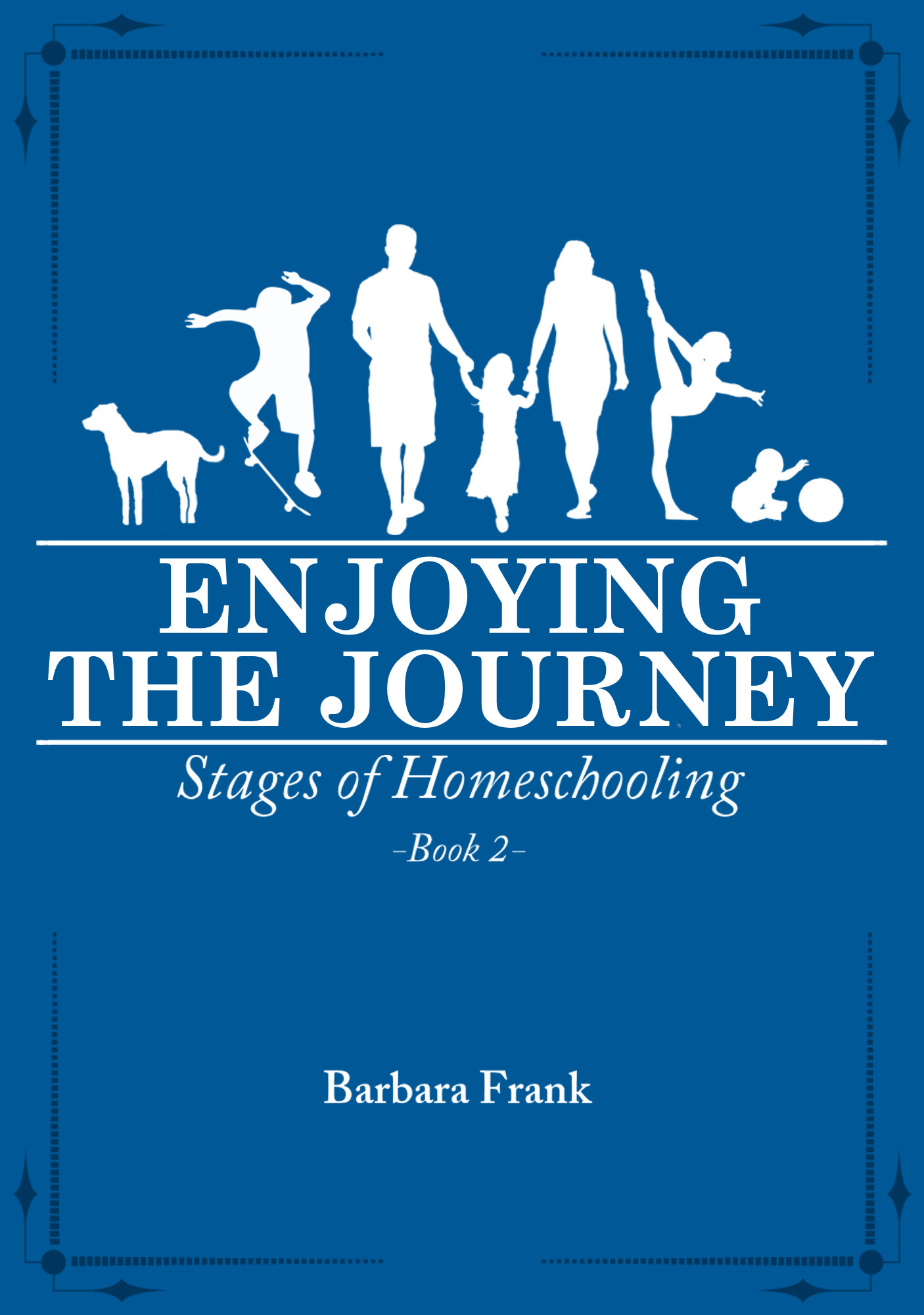
Stages of Homeschooling: Enjoying the Journey (Book 2)

I’m delighted to announce that the second eBook in our Stages of Homeschooling series has just been published at Amazon.com. Stages of Homeschooling: Enjoying the Journey has over 200 pages of encouragement and  information for the homeschooling parent with a few years of experience under her (or his) belt. And it’s a bargain at just $4.99! (I think eBooks should cost less than print books, don’t you?)

Here’s what you’ll find in Stages of Homeschooling: Enjoying the Journey:

Have you got a few years of homeschooling under your belt, and you’re looking for practical information and encouragement from someone who’s lived the homeschooling life?

If your answer is “yes,” then this is the book for you.

Barbara Frank just wrapped up 25 years of homeschooling four children, including one with special needs, and wants to share her experiences with those currently on the homeschool journey.  So she’s combined new material with some of her articles and blog posts into a series of four books called Stages of Homeschooling. Enjoying the Journey is the second book of the series.

Stages of Homeschooling: Enjoying the Journey is divided into eight sections:

“Working with Your Children” (Curriculum and its place in your homeschool, specific ideas for working with your children, and tactics for avoiding homeschool burnout)

“Raising Children You Can Live With 24/7” (An especially important consideration for homeschooling parents)

“Self-Care for the Homeschooling Parent” (How to keep yourself strong for the important job of homeschooling)

“Homeschool Challenges and Issues” (Handling difficulties that might crop up for you personally or for the homeschool community at large)

“Books and Resources I Have Known and Loved (and How to Find Them)”

“Homeschooling and Holidays” (A look at holidays from the vantage point of a homeschooling parent)

“For Girls Only” (A few thoughts for those of you raising daughters)

“Teaching Practical Skills” (Ideas for including this increasingly important topic in your homeschooling plans)

This book will encourage and enlighten you as you homeschool your children. It’s the second book in the Stages of Homeschooling series:

Stages of Homeschooling: Beginnings (Book 1)

Stages of Homeschooling: Enjoying the Journey (Book 2)

Stages of Homeschooling: Letting Go (Book 3)–COMING SOON!

Stages of Homeschooling: The Empty Nest (Book 4)–DUE LATER IN 2012

Learn more about this new title HERE. Don’t have an Amazon Kindle? No worries; just download one of their free apps, found HERE.

Why Public Schools are “Old School”

Parents choose homeschooling for many different reasons, but one common reason is that they’re unhappy with their local public school, or with public education in general.

Here’s a question to think about. What is the purpose of public school? Most people would answer that it’s where children get an education so that they graduate prepared to go out into the world on their own and support themselves.

Let’s take a look at what children experience in school on a daily basis:

  • They have to be there at an official starting time.
  • (If they don’t show up, they’ll have to explain their absence and might be penalized if they don’t have a good enough excuse.)
  • They’re to go to a certain room where they’ll depend on the teacher to give them their work.
  • They’re told what kind of work they’ll do; most of the time, they cannot choose what they want to do.
  • They cannot get up and leave the room; they have to stay put until an official release time.
  • They have to ask permission to go to the bathroom or get a drink of water; if they do either of these things too many times, they’ll be reprimanded.
  • They’re expected to stay in their seat and not wander around.
  • They’re regularly assessed by the teacher, who rewards those with good reports and penalizes those with bad reports.
  • They can’t eat until the prescribed meal time.
  • They can’t take a break whenever they need it; they have to wait until recess or lunchtime.
  • When they finish their work, they have to wait for the teacher to give them something new to work on.
  • They can’t go home until the bell rings.

Schools aren’t the only place where you’ll find this kind of environment. There’s another place where the daily routine is almost identical. Rereading that list (this time replacing the word “teacher” with the word “boss”) makes it clear that the school experience is designed to replicate the experience of the workplace; that is, the workplace that was common during the 20th century. Children in school were and are trained to be “good workers”: to get to work on time, to do what the boss says, and to accept the lack of autonomy inherent in the traditional hierarchical work environment. They experience this indoctrination for the bulk of childhood; thus it will be hard for today’s children to shake off their school-induced dependence on authority once they have to make it on their own in a world where all the rules have changed, and where self-sufficiency is back in style out of necessity.

(Excerpted from my book Thriving in the 21st Century: Preparing our Children for the New Economic Reality.)

When Grandparents Don’t Understand

You’re all pumped up about homeschooling, you love seeing your kids learn new things, and you love having the time to learn together. Yet there’s a fly in your ointment—your parents or your in-laws are opposed to what you’re doing.

This hurts. You want them to be happy for your family, to appreciate what you’re doing, and you certainly don’t want them to make trouble for you. Maybe it would help to look at the situation from their point of view.

I’m not saying they’re right…I’m just suggesting you put yourself in their place for a few minutes. Chances are good they’re in their 50s or 60s. That means they started going to school in the 1950s or 1960s. Their memories of school took place in a much different era. Teachers’ biggest concerns back then were kids chewing gum in class and running in the hallways, not bringing guns to class and ducking gang members in the hallways. Many of today’s grandparents picture school as the experience they remember, not the one that exists now.

Your parents or in-laws may also view your choice to homeschool your kids as a criticism of the way you or your spouse were educated. They probably chose to live in an area where there was a decent school, and they believe you got a good education. But to them, your choice of homeschooling may feel like a rejection of your education, and they’re taking it personally.

 Another possibility is that they truly believe the only place a child can learn to read, write and do math is in school. They became parents during an era when so-called experts, like Dr. Benjamin Spock, were almost worshipped as parenting gods. What people like Dr. Spock said was practically gospel to some people back then. Your parents or in-laws may view teachers as experts, but they still see you as their child (or the person their child married). They may like you, but that doesn’t mean they think you have the expertise to teach your kids.

There may be other, more personal, reasons your parents or in-laws would object to you homeschooling your kids; only you would know if that’s the case. But the fact remains that it hurts if they don’t support your decision. That discord may simmer under the surface, or it could result in outright hostility.

In most cases, the solution to this problem is time. As your children grow up to become happy, independent and smart young people, their grandparents will see that they’re doing fine. You can help this along by inviting them to your support group’s Project Night or science fair, sharing your children’s test scores with them, and involving them in field trips as well as projects you work on at home. Remove the mystery of homeschooling so they can see that it really is just a loving and involved family life. People fear what they don’t know; help your parents or in-laws to understand homeschooling, and show them the fruit it bears in your children’s lives so they can understand exactly why you would make such a choice.

(Excerpted from Stages of Homeschooling: Beginnings, my new eBook available only at Amazon.com for the Kindle. Learn how to use the free Kindle app on your pc HERE.)

Why Steal Tide?

So the laundry detergent Tide has become a popular target for thieves. Who knew? Seems to me that Tide’s neon orange bottle would be hard to hide, but apparently people are making Tide disappear quite easily, even stealing multiple bottles at a time.

My favorite part of the article describing this trend is the quote from the manufacturer:

“We don’t have any insight as to why the phenomenon is happening, but it is certainly unfortunate,” said Sarah Pasquinucci, a spokeswoman for Procter & Gamble.

Guess I’ll have to clue P&G in so they can solve this mystery: You charge too much for Tide! No one likes spending $10 or more on a bottle of laundry detergent. Hence the increase in theft and the use of Tide as payment for drugs and other illegal activities.

Those of us who aren’t inclined to steal have a different reaction to the ever-increasing price of detergent: we’re making our own. And it turns out that it not only saves us a bundle, but it’s healthier for our families because it doesn’t have all those unpronounceable chemicals in it.

A quick search for “homemade laundry detergent” will net you an amazing number of results on the search engine of your choice. I like this one.

I’ve been making my own liquid laundry detergent for a few years now and love it. Recently I began making powdered detergent in my food processor and I like that, too: now I use liquid for cold water loads and powder for warm/hot water loads. My current homemade powdered detergent is lavender-scented. It makes me smile every time I use it. And now that it’s warm enough to hang out the wash, my laundry joy is complete. Take that, Procter & Gamble!

Survival Skills for Kids: Cooking and Gardening

In her book The Prosperous Heart, Julia Cameron shares the story of Richard, an independent graphic designer who blamed his uneven income for causing him to have too much credit card debt. However, an assessment of his situation revealed that the bulk of his debt was due to his daily habit of eating dinner in restaurants:

“I couldn’t believe it was so simple,” he said. “If I ate out only twice a week, I could be out of credit card debt in a year. What I needed were groceries. The price of a salmon fillet at the supermarket was a third of what I had been paying in a restaurant.”

It’s easy for us to react to Richard’s epiphany with “Well, duh!” But the fact is that there’s an entire generation of young people raised on fast food and restaurant meals that don’t have a clue when it comes to preparing food for themselves.

This wouldn’t be such a problem if our economy was booming, and if earning an income high enough to support daily restaurant meals was easy. But the combination of inflation, shrinking incomes and high unemployment has made times difficult for Americans of all ages and especially young people, many of whom give into the ever-present drumbeat of “College! College!” and graduate with considerable student loan debt, along with a college degree that’s not always the golden ticket to jobs it was advertised to be.

When we fail to equip our young people to live self-sufficiently, we handicap them in the best of times, much less the worst. Right now in Greece, highly educated young people are leaving large cities because they can’t find work; instead, they’re trying to eke out an agricultural living in the country on land their grandparents abandoned years ago. Their desperation comes out of necessity, but at least they’re trying. Surely the task is easier for those who were taught to garden and cook.

We could learn from that example and teach our children such survival skills, but U.S. children continue to be fed a diet of useless social experiments masquerading as curriculum. The closest they get to cucumbers is being taught to put condoms on them in Sex Ed. Seems like teaching them to make a fresh cucumber, tomato and onion salad would be a little more appropriate given our dicey economic future.

However, homeschooled children have the opportunity to be taught how to cook and garden by their parents as part of their daily education. These learning activities already occur naturally in the lives of many homeschooled children, and provide them with enough knowledge and experience that they emerge as young adults who can take care of themselves in hard times as well as good times. A bonus is the closeness that develops between parent and child. The lost art of preparing meals together is what once kept families close, and homeschooling families can easily prove it still works.

As for gardening, even modern children (once pulled away from their phones and iPods) enjoy the sight of the seeds they planted later popping up from the soil and quickly morphing into green plants. Once they taste their first fresh tomatoes and green beans, they’re usually hooked on gardening. For many of them, gardening will become a lifelong pleasure as well as a survival skill.

When I homeschooled my children, I could see that including cooking and gardening in our homeschool was fun and educational for them. It was well worth the effort. Remember, the time you spend teaching your children to garden and cook now will eventually result in that many fewer young people trying to feed themselves armed only with maxed-out credit cards later on.